How the System Really Works

What organic fertilizers actually are

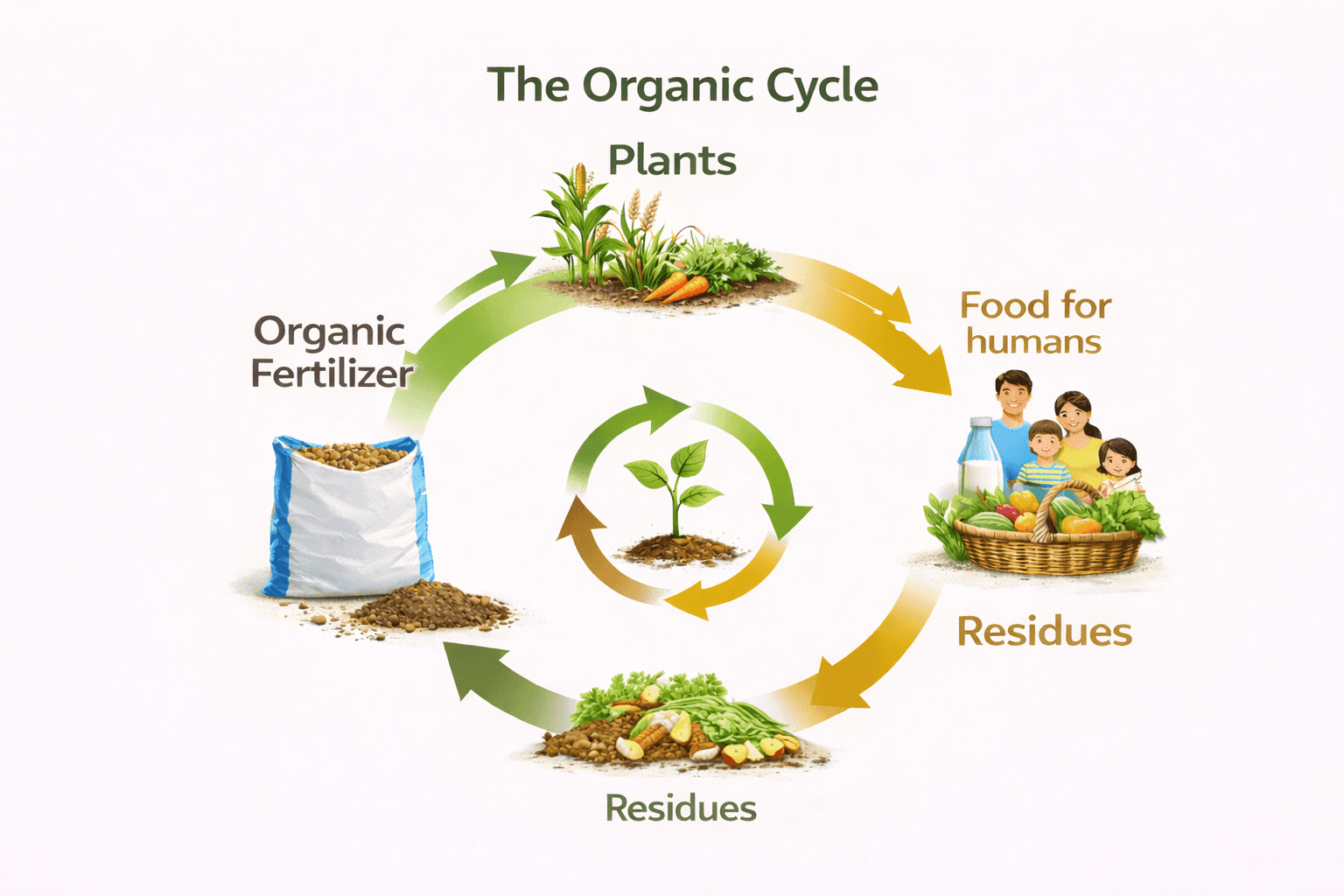
An honest explanation of how organic fertilisers fit into the food system. This post breaks down the organic cycle — from plants to food, residues and back to soil — and explains why nutrients, organic matter and less desirable elements all circulate together. Circularity is not an idea, it’s a system.
Thumbnail
Thumbnail

What Organic Fertilizers actually are

Everything in agriculture moves in loops.

Plants take nutrients from the soil.
Those plants become food for people and feed for animals.
What is not converted into food returns as organic residues.

From that stream:

  • manure

  • plant residues

  • digestate

  • organic by-products

organic fertilisers are produced.

Those fertilisers are then applied back to land, where plants start the cycle again.

That is the basic logic of circular agriculture.

And one rule always applies:

Organic fertilisers don’t create nutrients.
They redistribute what is already in the system.


Organic fertilizers serve three functions at the same time

Organic fertilizers are often discussed as if they do one thing.

In reality, they always combine three functions:

  1. Nutrient recycling
    Returning nutrients from food and feed systems back to agriculture

  2. Soil restoration & organic matter input
    Supplying carbon that supports soil structure, biology and buffering capacity

  3. Plant nutrition
    Providing nutrients in forms and ratios that crops can actually use

These functions overlap — but they are not identical.

A product can recycle nutrients well
while still being suboptimal for plant nutrition.

That distinction matters.


Circularity preserves composition, it does not correct it

Circular systems follow mass balance.

What enters the food and feed chain:

  • returns via manure or residues

  • ends up in organic fertilisers

  • re-enters the soil system

This applies to:

  • nitrogen

  • phosphorus

  • potassium

  • trace elements

  • and less desired substances

Circularity is neutral.
It recycles everything, not selectively.
Why a single input stream is rarely enough

Take animal manure as a single input.

Typical manure-based profiles show:

  • high phosphorus levels

  • moderate nitrogen availability

  • uneven trace element supply

This reflects:

  • animal diets

  • feed supplements

  • housing systems

  • regional surpluses

Using manure alone means those imbalances
are simply passed on.


Formulation is where circularity becomes agronomy

This is why we use multiple organic ingredients.

By combining different inputs, we can:

  • broaden the nutrient profile

  • reduce phosphorus dominance

  • supply missing trace elements

Each ingredient compensates for what another lacks.

The goal is not complexity.
The goal is balance.

Plants don’t respond to labels.
They respond to ratios, availability and timing.


Balance matters for soils and crops

Unbalanced inputs affect more than one season.

Over time:

  • phosphorus accumulates

  • certain deficiencies persist

  • corrective inputs become necessary

A broader nutrient profile helps:

  • stabilise soil chemistry

  • support biological processes

  • reduce long-term corrections

That benefits both:

  • crop performance

  • and soil resilience


Everything comes back -> so design responsibly

Circularity is powerful, but unforgiving.

Everything that goes into an organic fertiliser:

  • comes back to the field

  • sooner or later

That includes:

  • nutrients

  • salts

  • trace elements

  • unwanted substances

Which is exactly why formulation matters.

Organic fertilisers are not defined by origin,
but by what they carry through the system.


The takeaway

Organic fertilisers combine three roles:

  • recycling nutrients

  • restoring soils and adding organic matter

  • feeding plants

Using a single input stream recycles efficiently,
but preserves imbalance.

Using multiple ingredients allows circularity
to work with agronomy instead of against it.

Circular systems don’t optimise themselves.
They need to be designed.

What Organic Fertilizers actually are

Everything in agriculture moves in loops.

Plants take nutrients from the soil.
Those plants become food for people and feed for animals.
What is not converted into food returns as organic residues.

From that stream:

  • manure

  • plant residues

  • digestate

  • organic by-products

organic fertilisers are produced.

Those fertilisers are then applied back to land, where plants start the cycle again.

That is the basic logic of circular agriculture.

And one rule always applies:

Organic fertilisers don’t create nutrients.
They redistribute what is already in the system.


Organic fertilizers serve three functions at the same time

Organic fertilizers are often discussed as if they do one thing.

In reality, they always combine three functions:

  1. Nutrient recycling
    Returning nutrients from food and feed systems back to agriculture

  2. Soil restoration & organic matter input
    Supplying carbon that supports soil structure, biology and buffering capacity

  3. Plant nutrition
    Providing nutrients in forms and ratios that crops can actually use

These functions overlap — but they are not identical.

A product can recycle nutrients well
while still being suboptimal for plant nutrition.

That distinction matters.


Circularity preserves composition, it does not correct it

Circular systems follow mass balance.

What enters the food and feed chain:

  • returns via manure or residues

  • ends up in organic fertilisers

  • re-enters the soil system

This applies to:

  • nitrogen

  • phosphorus

  • potassium

  • trace elements

  • and less desired substances

Circularity is neutral.
It recycles everything, not selectively.

Why a single input stream is rarely enough

Take animal manure as a single input.

Typical manure-based profiles show:

  • high phosphorus levels

  • moderate nitrogen availability

  • uneven trace element supply

This reflects:

  • animal diets

  • feed supplements

  • housing systems

  • regional surpluses

Using manure alone means those imbalances
are simply passed on.


Formulation is where circularity becomes agronomy

This is why we use multiple organic ingredients.

By combining different inputs, we can:

  • broaden the nutrient profile

  • reduce phosphorus dominance

  • supply missing trace elements

Each ingredient compensates for what another lacks.

The goal is not complexity.
The goal is balance.

Plants don’t respond to labels.
They respond to ratios, availability and timing.


Balance matters for soils and crops

Unbalanced inputs affect more than one season.

Over time:

  • phosphorus accumulates

  • certain deficiencies persist

  • corrective inputs become necessary

A broader nutrient profile helps:

  • stabilise soil chemistry

  • support biological processes

  • reduce long-term corrections

That benefits both:

  • crop performance

  • and soil resilience


Everything comes back -> so design responsibly

Circularity is powerful, but unforgiving.

Everything that goes into an organic fertiliser:

  • comes back to the field

  • sooner or later

That includes:

  • nutrients

  • salts

  • trace elements

  • unwanted substances

Which is exactly why formulation matters.

Organic fertilisers are not defined by origin,
but by what they carry through the system.


The takeaway

Organic fertilisers combine three roles:

  • recycling nutrients

  • restoring soils and adding organic matter

  • feeding plants

Using a single input stream recycles efficiently,
but preserves imbalance.

Using multiple ingredients allows circularity
to work with agronomy instead of against it.

Circular systems don’t optimise themselves.
They need to be designed.

Field

Grow something great together.

Grow something great together.

Grow something great together.

Whether you're exploring a new product line or looking for a reliable long-term supplier -we supply high-value organic fertilizers with a unique value for money that help distributors stand out.
Icon
Honest
Icon
Long-Term
Icon
Functional