Context & Markets
Why we don't sell organic fertilizers in The Netherlands
The Netherlands is a very small country with an exceptionally high livestock density. As a result: animal manure production far exceeds land capacity nutrient application is constrained by regulation, not by crop demand manure handling is primarily a disposal and logistics issue
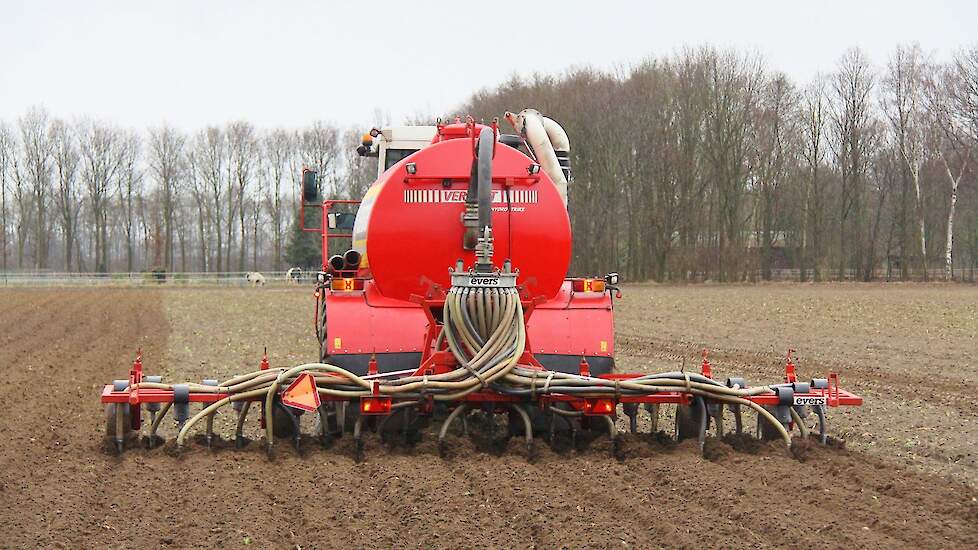
Why next-generation organic fertilisers like ours don’t make sense in the Netherlands
This may sound counterintuitive coming from a company that develops next-generation organic fertilisers.
But it needs to be said clearly:
Our fertilisers are usually not very relevant for Dutch agriculture.
Not because they don’t work.
But because they don’t solve a real problem here.
The Dutch reality: manure is not scarce — it’s excessive
The Netherlands is a very small country with an exceptionally high livestock density.
As a result:
manure production exceeds land capacity
nutrient use is limited by regulation, not crop demand
manure handling is mainly a disposal and logistics issue
This leads to a situation that surprises many people outside the Netherlands:
Arable farmers are often paid to accept manure.
In practice:
manure is delivered at very low cost
or with a gate fee paid to the farmer
in some regions up to €30–40 per m³
That single fact defines the market.
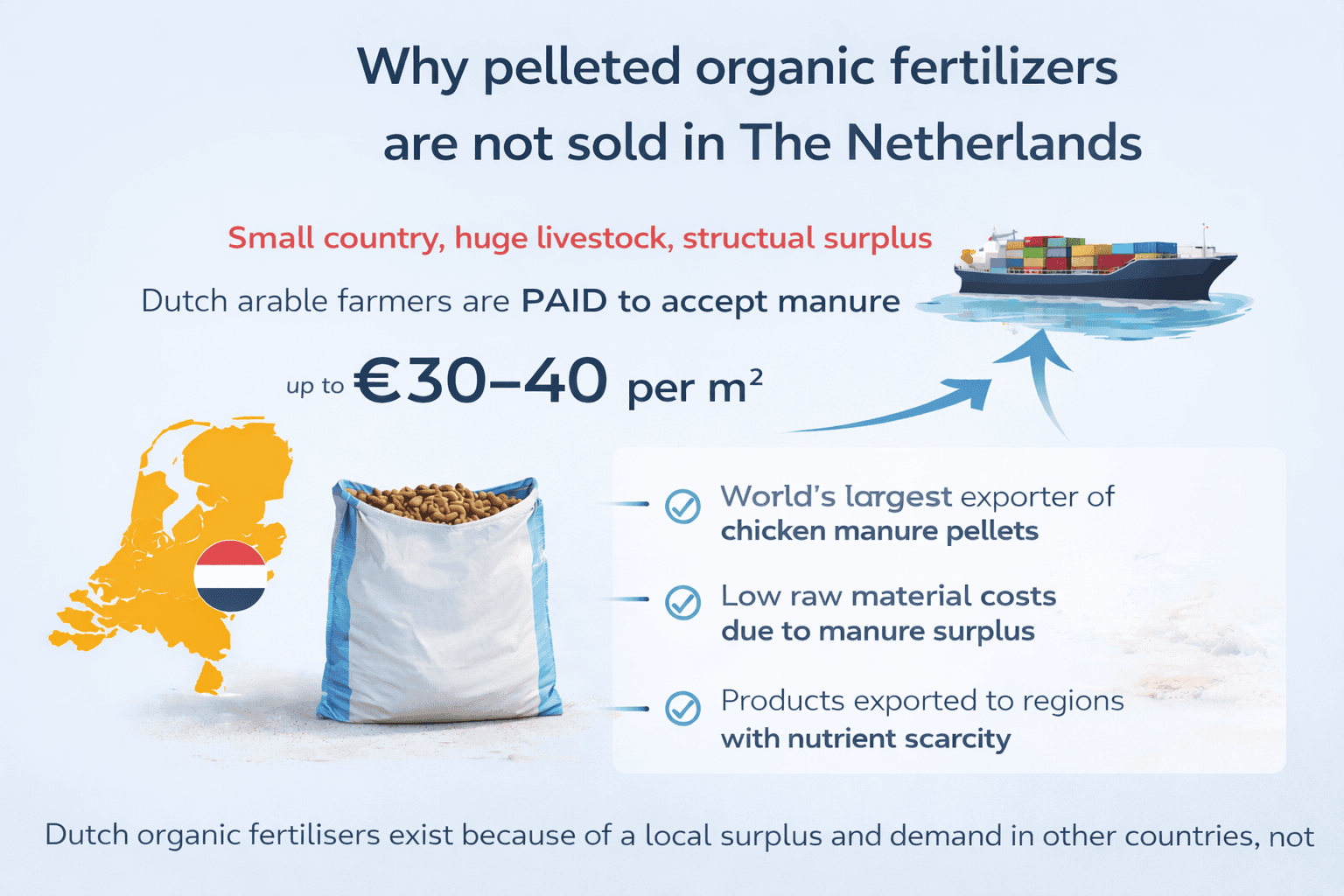
When farmers are paid to take nutrients, adding more rarely helps
In large parts of Dutch arable farming:
nitrogen is not limiting
phosphorus is not limiting
organic matter inputs are already high
Farmers are constrained by:
application ceilings
timing rules
emission limits
Not by a lack of nutrients.
In this context, adding another organic fertiliser:
does not improve nutrient efficiency
does not improve farm economics
does not address the main bottlenecks
It simply adds volume to an already saturated system.
Manure surplus drives export and not domestic demand
Ironically, the same surplus that limits relevance at home
is why the Netherlands plays such a dominant role internationally.
Despite its size, the Netherlands is by far the largest exporter of chicken manure pellets worldwide.
Not because Dutch soils need them — but because other regions do.
The surplus leads to:
low domestic manure prices
abundant organic raw materials
large-scale processing capacity
a strongly export-oriented fertiliser industry
Many Dutch organic and organo-mineral fertilisers are designed from the start for markets where:
nutrients are scarce
soils are depleted
organic inputs are limited
mineral fertilisers dominate
In short:
Dutch organic fertilisers exist because of surplus, not because Dutch agriculture lacks nutrients.
“But organic matter is always good, right?”
Organic matter is valuable.
But context matters.
In many Dutch systems:
soil organic matter levels are already relatively high
crop residues are returned
manure applications are routine
Additional organic inputs often result in:
diminishing returns
limited yield response
no clear economic benefit
Organic or biological does not automatically mean:
necessary
logical
effective
Especially not in a system defined by oversupply.
Why we say this — even though we are based in the Netherlands
We are based in the Netherlands.
We work with Dutch raw materials.
We operate inside this system.
That is exactly why we are explicit about its limits.
Our next-generation fertilisers are developed to solve problems related to:
nutrient scarcity
depleted soils
lack of organic inputs
overreliance on mineral fertilisers
Those problems simply do not define mainstream Dutch agriculture.
Pretending otherwise would be misleading.
Conclusion
Next-generation organic fertilisers work best where nutrients and organic matter are scarce.
The Netherlands has the opposite problem: structural surplus.
That is why:
manure is cheap
farmers are paid to accept it
organic fertilisers are exported at scale
Including by us.
Good products are context-dependent.
Ignoring that doesn’t help farmers — it confuses them.