How the System Really Works
Global Market Rapport for Organic Fertilizers - 2026 - Trends & Opportunities
Full and free market rapport, Local vs Global Trends, a rapidly growing and fast evolving market with opportunities for distributors, farmers and manufacturers
1. Organic fertilisers: a broad and evolving category
Organic fertilisers are not a single product type.
Globally, they exist in many forms, including:
liquid organic fertilisers
pelletised manure-based products
granular organic and organo-mineral blends
compost and compost-derived inputs
raw and processed animal manures
digestates from biogas installations
insect-derived fertilisers (e.g. frass)
Despite differences in form and processing intensity, organic fertilisers share a common role:
recycling nutrients and organic matter back into food production systems [1][2].
Understanding this diversity is essential when analysing both local initiatives and scalable, export-oriented production.
2. Market size and growth: no longer a niche
The global organic fertiliser market is growing steadily and structurally.
Current estimates indicate:
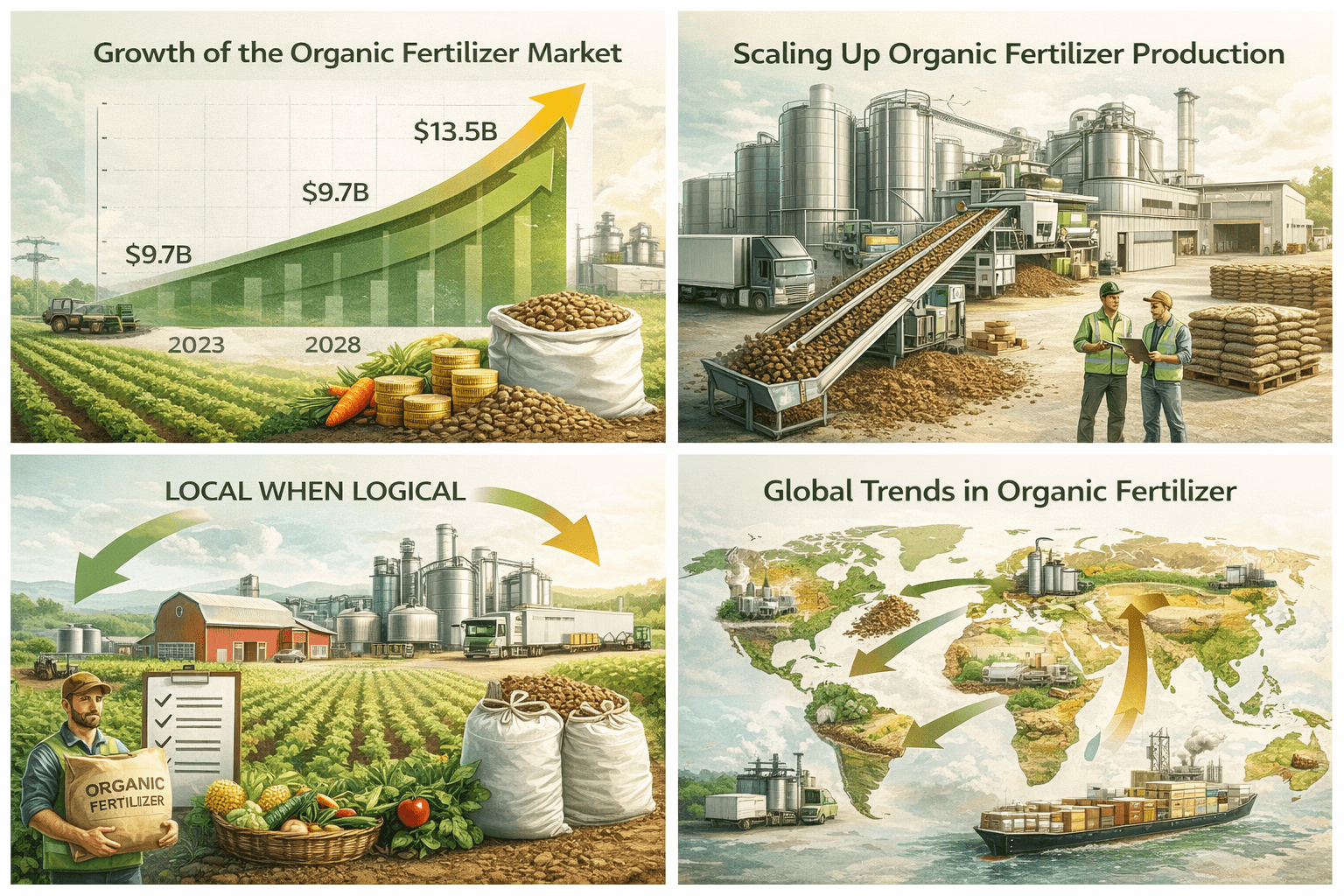
~USD 9.7 billion market size in 2023
projected growth to ~USD 13.5 billion by 2028
representing an average annual growth rate of ~6.5–7% [8][15]
This growth is driven by multiple, reinforcing factors:
expansion of organic and residue-free food production
soil degradation after decades of chemical fertiliser use
regulatory pressure on mineral fertilisers
rising costs and volatility of synthetic inputs
increased focus on soil health and long-term productivity
In specific sub-segments, growth is even faster.
Insect-based fertilisers, for example, are projected to grow at >20–24% CAGR over the coming decade [9].
The market is no longer experimental — it is scaling.
3. Local production is increasing — and it makes sense
Across all continents, local organic fertiliser production is increasing.
This is visible in:
Europe
Latin America
North America
Central America
Africa
Asia
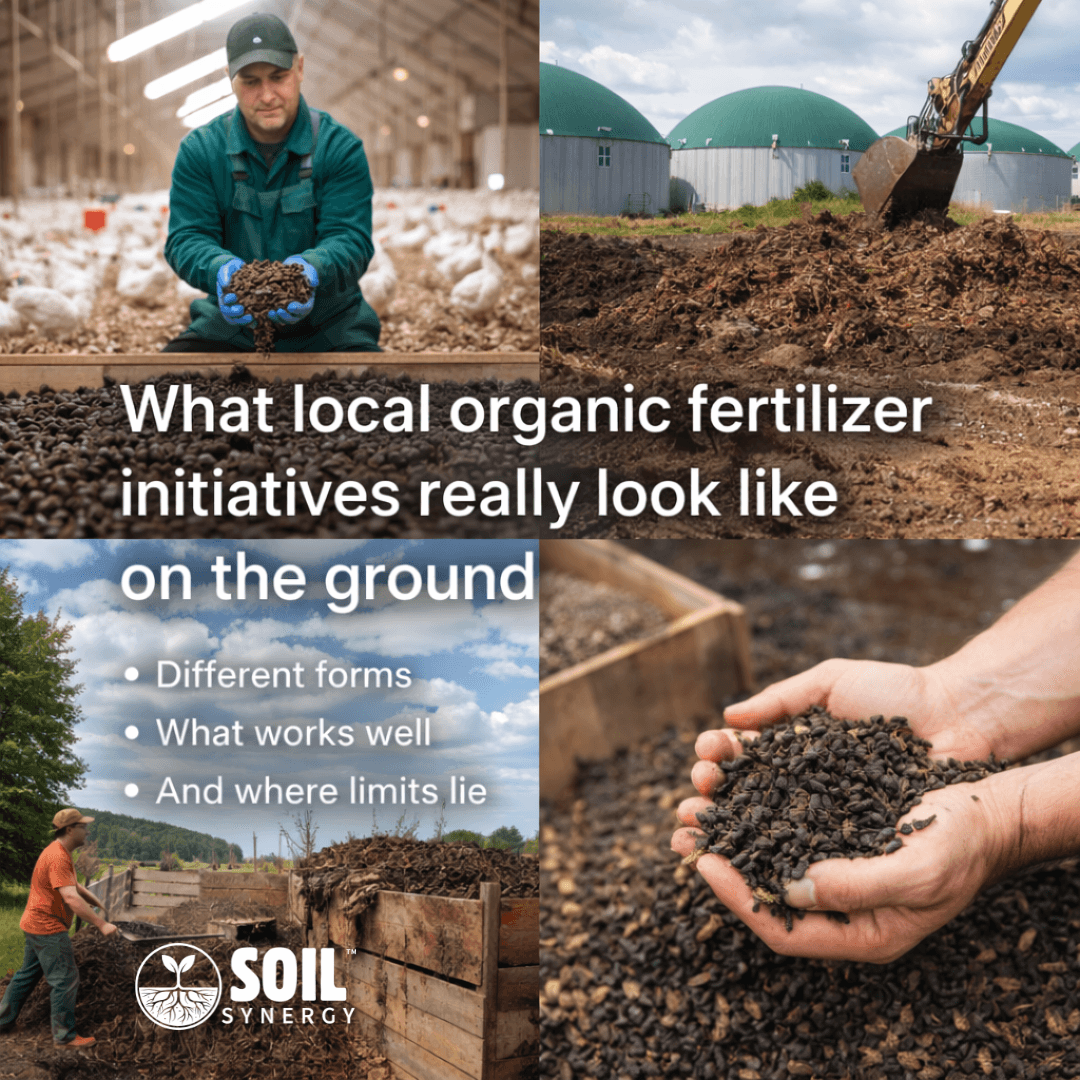
Local initiatives include:
biogas plants valorising digestate
poultry manure pellet processors
composting facilities
insect farming operations
residue-based fertiliser hubs
These developments are driven by:
availability of local organic residues
rising logistics and energy costs
sustainability policies
circular economy incentives
food system self-sufficiency goals [3][4][7][9]
Local production is logical, efficient and often unavoidable.
4. The structural limits of “local only”
However, localisation also has inherent limitations.
Local systems are typically constrained by:
volume tied to regional residue availability
seasonal input streams
variable nutrient composition
limited blending and standardisation
inconsistent supply at scale
As a result:
local products often perform well regionally
but struggle to meet the consistency, volume and reliability required for professional, multi-region distribution
This is not a flaw — it is a structural characteristic of local circular systems [11].
5. Global supply is still driven by livestock-dense regions
Despite the rise of local initiatives, global organic fertiliser volumes are still dominated by countries with high livestock density.
Key producing and exporting countries include:
Netherlands
Italy
Spain
France
United States
China
India
Malaysia
Australia
These countries benefit from:
structural nutrient surpluses
abundant organic raw materials
mature processing infrastructure
export-oriented logistics networks [12][13][14]
Organic fertiliser production in these regions exists primarily because of surplus, not domestic scarcity.
The map below highlights regions with structural Phosporus surpluses (typically livestock-dense areas) and deficit.
This imbalance explains why organic fertilizers are traded internationally: surplus regions will focus on export, while deficit regions rely on imported, concentrated nutrients. Trade flows are driven by nutrient density and logistic costs, rather than borders or ideals of local circularity.
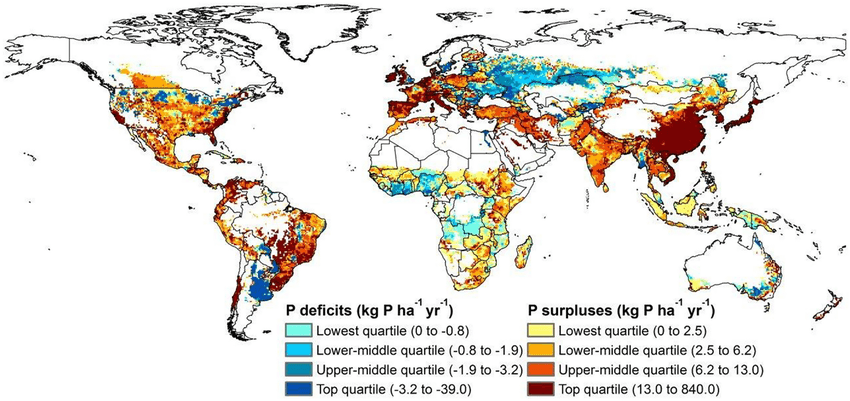
Source: (Bouwman et al., 2017)[19]
6. The Netherlands: a global export hub
The Netherlands is a clear example of this dynamic.
Over 300,000 tonnes of Dutch fertiliser pellets are shipped annually
exports reach more than 75 countries worldwide
export volumes have grown at approximately 15% per year since 2016 [3]
Initially, exports were mainly directed to neighbouring European countries.
Today, a significant share flows to:
Asia
Africa
Latin America [6]
In Southeast Asia, demand is particularly strong due to:
decades of intensive chemical fertiliser use
declining soil organic matter
increasing interest in organic alternatives
Dutch pellets are used as:
soil restorers
organic nutrient sources
blending inputs for local fertiliser production
This illustrates how nutrients move internationally from surplus to deficit regions.
7. Consolidation: major fertiliser players enter organics
With sustained market growth, large fertiliser companies are entering the organic segment.
Examples include:
Yara → Agribios (Italy): expansion into organic inputs and organo-mineral fertilisers [4][10]
EuroChem → Fertilizers with enhanced organic components
Nutrien expanding biological and organic portfolios in North America
ICL investing heavily in bio-based and specialty fertilisers
These players bring:
capital
R&D capacity
regulatory expertise
global distribution networks
This confirms that organic fertilisers are no longer fringe products, but strategic components of future nutrient portfolios [16][17].
8. Farmers buy both local and international — for different reasons
An important shift is happening at farm level.
Farmers increasingly:
source local organic inputs for cost efficiency and circularity
complement them with imported or processed organic fertilisers for consistency, nutrient balance and reliability
Local and international products:
do not compete directly
but fulfil different agronomic and logistical roles
This hybrid sourcing model is becoming the norm.
9. Key global trends shaping the market
9.1 Strong and sustained market growth
Driven by:
organic food demand
soil health awareness
sustainability regulation
pressure on chemical fertilisers [8][11]
9.2 Consolidation and professionalisation
Large fertiliser companies acquire organic specialists to secure future relevance [4][16].
9.3 International nutrient flows
Processed organic fertilisers move from:
livestock-dense regions
tonutrient-depleted agricultural systems [6][12]
9.4 Innovation in sources and technology
insect-based fertilisers
advanced composting
digestate upgrading
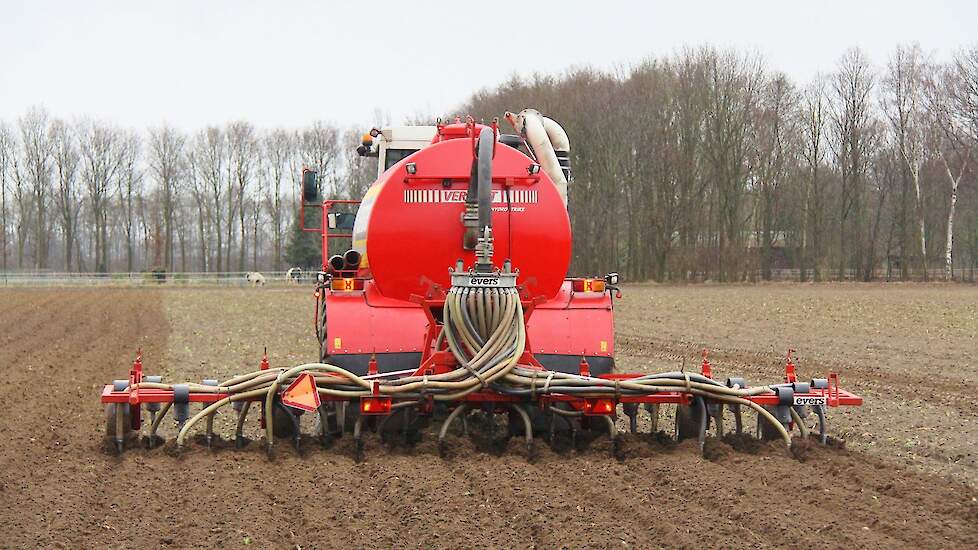
concentrated pellets and liquids
precision application tools [9][18]
9.5 Changing perceptions
Organic fertilisers are increasingly valued for:
soil structure improvement
long-term productivity
reduced environmental impact
Chemical fertilisers are gradually losing dominance in some regions due to:
emission concerns
soil degradation
regulatory pressure [11][12]
10. Conclusion
The organic fertiliser market is growing — globally and structurally.
Local production is increasing because it makes sense
Scalable production remains essential for reliability and trade
Farmers increasingly combine both
The future is not local versus global, but local where logical, scalable where necessary.
Understanding that distinction is key for distributors, producers and policymakers alike.
Sources
FAO – Organic Fertilizers and Soil Health
FiBL – The World of Organic Agriculture
Wageningen Economic Research – Manure Processing and Export
New AG International – Yara Acquires Agribios
World Bank – Logistics Costs in Agriculture
FAO – Global Nutrient Flows
European Commission – Circular Economy Action Plan
BCC Research – Global Organic Fertilizer Market
Meticulous Research – Insect Fertilizer Market Forecast
Yara International – Strategic Expansion into Organic Inputs
FAO – Soil Degradation and Nutrient Management
International Fertilizer Association – Organic and Bio-based Fertilizers
USDA – Organic Fertilizer Market Overview
OECD – Agricultural Nutrient Balances
IMARC Group – Organic Fertilizer Market CAGR
Nutrien Investor Reports – Biological and Organic Strategy
ICL Group – Specialty Fertilizers & Bio-based Inputs
IEA Bioenergy – Digestate and Residue Valorisation
Bouwman, A. F., Beusen, A. H. W., Lassaletta, L., van Apeldoorn, D. F., van Grinsven, H. J. M., Zhang, J., & van Ittersum, M. K. (2017). Lessons from temporal and spatial patterns in global use of nitrogen and phosphorus fertilizers on cropland.